
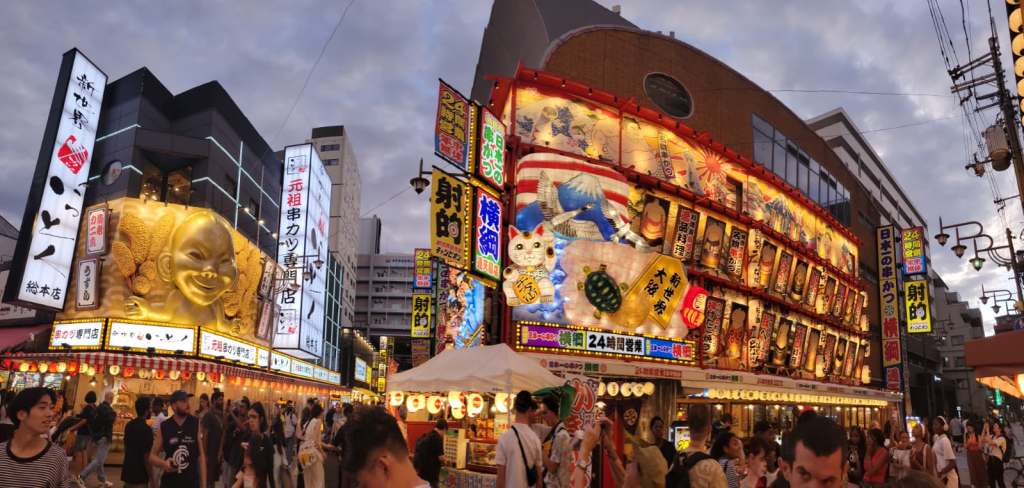

¿Escuché “Billiken” o fue una ilusión creada por la mezcla entre el cansancio provocado por miles de horas de viaje, la humedad y los 30 grados (atípicos en octubre) en Osaka? Estoy casi segura que el guía del tour gastronómico por la zona de Shinsekai dijo algo que sonó parecido, claro que no con acento rioplatense 🙂
Cuando planificamos nuestros viajes desde la computadora todo parece sencillo. Creemos que el jet lag será apenas un detalle. Nada más lejos de la realidad. Viajar a Japón desde Estados Unidos fue entrar en un descalabro temporal y al llegar a destino sentí que mi alma se había perdido en alguna escala. Unas horas después comenzó la lucha por vencer al sueño, convencer al cuerpo de seguir y sostener los planes que, en abstracto y sin el peso del jet lag eran más que razonables.
Did I hear “Billiken” or was it an illusion created by the combination of fatigue from thousands of hours of travel, humidity, and 30 degrees Celsius (unusual for October) in Osaka? I’m almost certain that the guide on the food tour of the Shinsekai area said something that sounded similar, though of course not with a Spanish rioplatense accent 🙂
When we plan our trips on the computer, everything seems simple. We think jet lag will be a minor detail. Nothing could be further from the truth. Traveling to Japan from the United States was like entering a temporary breakdown, and when I arrived at my destination, I felt like my soul had been lost somewhere along the way. A few hours later, the struggle to overcome sleepiness began, convincing my body to keep going and stick to the plans that, in theory and without the weight of jet lag, were more than reasonable.


Así estaba yo, en modo avión, suspendida entre husos horarios, formando parte de un tour de comidas y mirando unas figuras sonrientes, similares a budas sentados con sus pies apuntando hacia adelante.
El guía nos invitó a que tocáramos esos piecitos para atraer la buena suerte. Me incliné y vi un cartel en el que decía Billiken. El cansancio desapareció. Volvió la conexión.
There I was, in airplane mode, suspended between time zones, taking part in a food tour and looking at smiling figures, similar to Buddhas sitting with their feet pointing forward.
The guide invited us to touch those little feet to bring good luck. I leaned over and saw a sign that said Billiken. My tiredness disappeared. The connection returned.
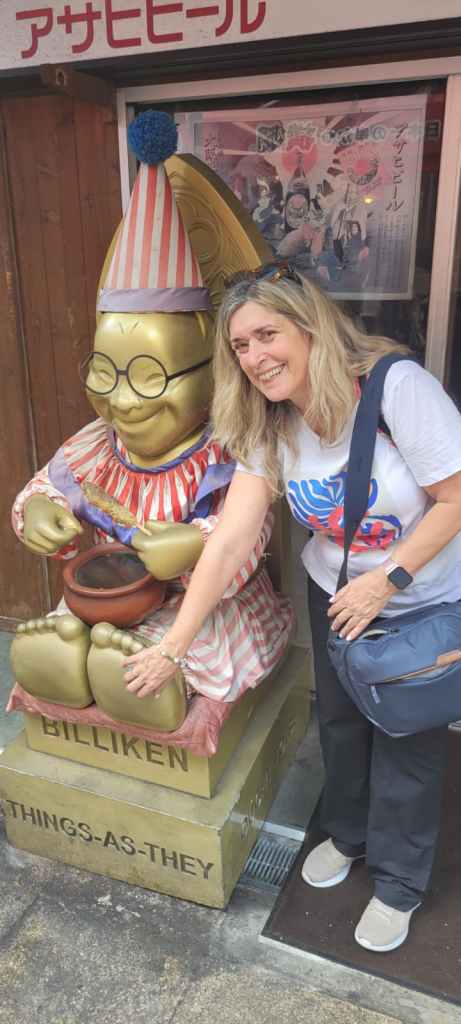
¿Se puede explicar una emoción? ¿Puede una palabra despertar un recuerdo que creíamos perdido? Billiken funcionó como un puente inesperado: un nombre familiar y a la vez lejano que unió Osaka con Villa Ballester. En un instante me llevó de la mujer que soy a la nena que pasaba las páginas de aquella revista infantil que mis papás me compraban. Y junto a ese recuerdo el sabor amargo de saber que no podría compartir la experiencia con ellos.
Is it possible to explain an emotion? Could a word bring back a memory we thought was lost? Billiken served as an unexpected bridge: a familiar and yet distant name that connected Osaka with Villa Ballester. In an instant, it took me from the woman I am today to the little girl who used to turn the pages of that children’s magazine my parents bought me. And along with that memory came the bitter taste of knowing that I couldn’t share the experience with them.

De regreso al hotel quise saber todo sobre Billiken y en especial si existía una conexión entre la revista y esos muñecos sonrientes.
Leí que es la mascota no oficial de Osaka y que la figura nació del trabajo de Florence Pretz, una artista estadounidense. No se sabe con exactitud cómo fue que llegó y se hizo popular en esta ciudad japonesa.
Tampoco supe si Constancio Vigil, fundador de la revista Billiken en Argentina en 1919, descubrió al personaje en Kansas o en Osaka. Sin embargo no hay dudas de que se inspiró en esa figura para darle nombre a la revista y la prueba está en la tapa del primer número.
Back at the hotel, I wanted to know everything about Billiken, especially if there was a connection between the magazine and those smiling figures.
I read that he is the unofficial mascot of Osaka and that the character was created by Florence Pretz, an American artist. It is not known exactly how he arrived and became popular in this Japanese city.
I also didn’t know if Constancio Vigil, founder of Billiken magazine in Argentina in 1919, discovered the character in Kansas or Osaka. However, there is no doubt that he was inspired by this figure to name the magazine, and the proof is on the cover of the first edition.

Esta no fue la primera conexión emocional del viaje. Apenas aterrizamos gestionamos el Kansai pass una tarjeta de transporte para turistas y me sorprendió que la imagen que eligieron para ilustrarla fuera la de Astroboy (Atom 鉄腕アトム). Un dibujo animado que había llegado a la Argentina en los años 70 y veía por televisión en la misma época que llegaba a mis manos la revisa Billiken y también Anteojito.
This wasn’t the first emotional connection of the trip. As soon as we landed, we got the Kansai Pass, a transportation card for tourists, and I was surprised that the image they chose to illustrate it was Astroboy (Mighty Atom 鉄腕アトム). It was a cartoon that had come to Argentina in the 1970s, and I watched it on television at the same time that I got my hands on Billiken magazine and Anteojito.

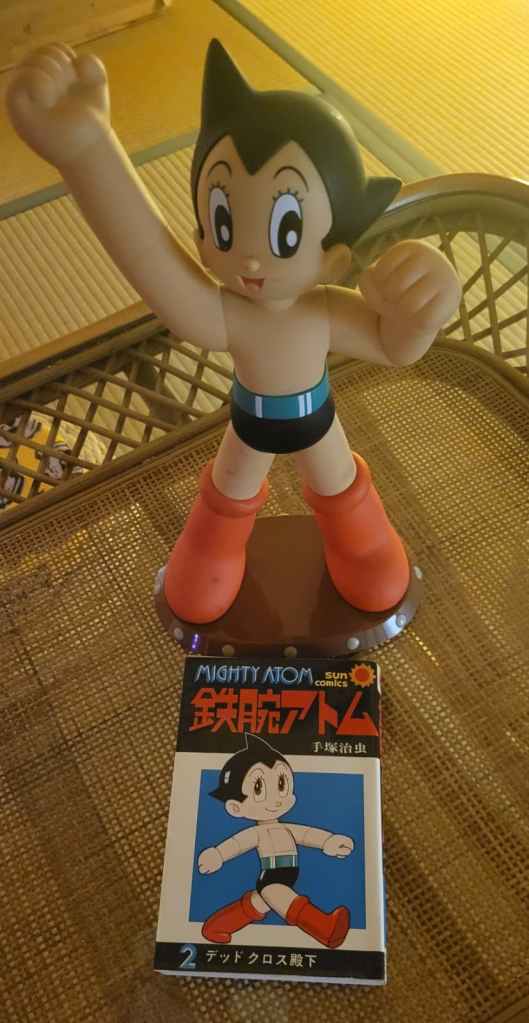
No sabía que unos días después en la isla de Naoshima, volvería a encontrarme con este personaje. La casa donde nos alojamos parecía una pequeña galería de arte donde destacaban muñecos de Astroboy, ilustraciones enmarcadas y libros de historietas. Los guiños a mi infancia continuaban.
I didn’t know that a few days later on the island of Naoshima, I would meet this character again. The house where we stayed looked like a small art gallery, featuring Astroboy (Mighty Atom) dolls, framed illustrations, and comic books. The reminders of my childhood continued.


Siento que viajar es mucho más que diseñar planes: es mantenernos atentos, disponibles, con la mirada curiosa. También creo que no hace falta viajar para que esto ocurra. En lo cotidiano también podemos sorprendernos si nos conectamos, si estamos presentes. Es una cuestión de actitud.
I feel that traveling is much more than making plans: it’s about staying alert, open, and curious. I also believe that you don’t have to travel for this to happen. We can also be surprised in our daily lives if we connect with ourselves and stay present. It’s a matter of attitude.



 VIAJES CRONICAS ARTE
Deja un comentario