
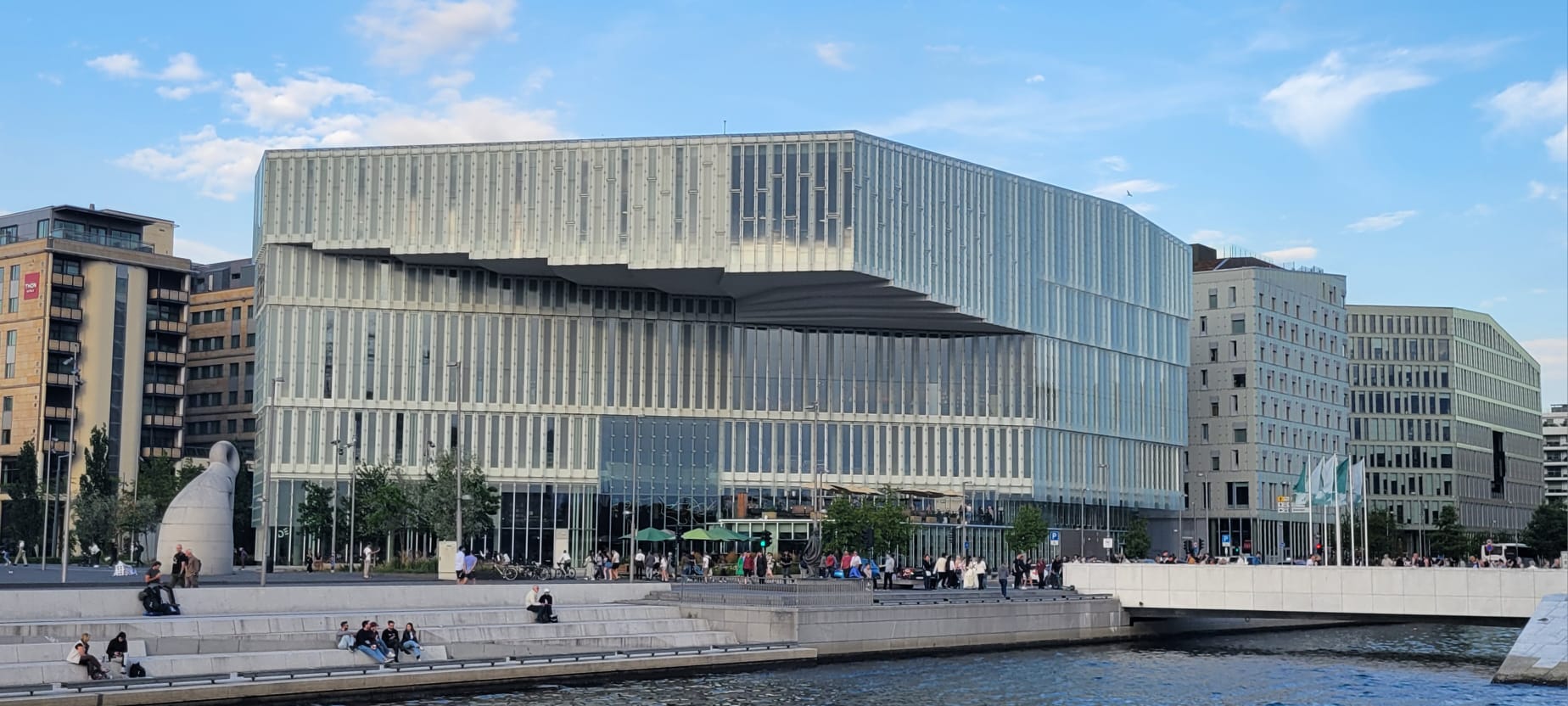
Oslo, Norway
Leer en Español

Before traveling to Oslo, I got in touch with Sigrun Aas who works at the Deichman Bjørvika Library because I wanted to learn a little more about its history and how it operates. Sigrun was kind enough to arrange a meeting with one of the staff members, but unfortunately, I wasn’t able to make it at the appointed time. I arrived a little later, and before leaving, I left a handwritten note on the counter to thank her for arranging the meeting. I didn’t know it at the time, but that small gesture would end up opening the door to an unexpected connection.
During my visit, I walked through the building, which opened in 2020 and is located across from the Oslo Opera House and very close to the Munch Museum, although the history of the library dates back to 1785. This new space is modern, bright, and open, featuring various areas that invite visitors to read, work, meet up, or simply have a cup of coffee.
It could have all ended there, but a few days later, Sigrun put me in touch with someone else at Deichman, Ana María Figueroa, who, to my surprise, is also Argentine. I was able to send her some questions to get an inside look at the library: how it operates, its relationship with the community, and some of the unique features that make it much more than just a place to look for books.
Here is our conversation, along with a little more information about this library, which is definitely worth adding to your itinerary if you’re traveling to Oslo. I’m very grateful to Sigrun and Ana María for their time, their attention, and for making this interview possible.

LzT: Deichman has a history of more than two centuries, but this building opened in 2020. What changed with the move to Bjørvika? Where was it located before?
AMF: The main Deichman Library was located at Arne Garborgs pl. 4 in Oslo. So much changed with the move to Bjørvika! A few highlights: Public access to available materials, the variety of items members can borrow (Deichman Bjørvika lends not only books, but also audiobooks, movies, sheet music, instruments, sewing machines, embroidery machines, sound mixing consoles, study rooms, meeting rooms, etc.), and, most importantly, the current vision of the library as a space for debate, gathering, study, and much more. Deichman Bjørvika also offers the use of a small movie theater on the third floor and a larger one in the basement, where we screen free movies for children on weekends. We also have a hall with a capacity of 150 people (Deichmansalen) where concerts, lectures, conferences, and other events are held.

LzT: When you walk into the building, you get the feeling that the library was designed for much more than just looking for books. How would you define Deichman’s role today?
AMF: Last year, we had nearly 2.5 million visitors in Bjørvika alone and 5,875,000 across the entire Deichman system. Considering that Oslo has a population of about 729,000, that works out to nearly 8.1 visits per resident. Oslo residents love libraries in general and Bjørvika in particular. At 8 a.m. when we open, there are already people waiting to get in and secure the best spot. Plus, there are very few days a year when Bjørvika is closed. We’re open every day of the week from 8 a.m. to 10 p.m. and on Saturdays and Sundays from 10 a.m. to 6 p.m. There’s no excuse not to read! 😊
The City of Oslo, which “owns” Deichman, continues to invest in its 22 libraries. This underscores the importance of Deichman to the city. We are the most-visited cultural institution in the country and the only one that did not close even during the pandemic.

LzT: What spaces or services tend to surprise first-time visitors the most?
AMF: A visitor once told me, “There’s only one thing missing here: a place to stay overnight 😊” “We’re working on it,” I replied. I think the entire library is quite impressive. It has 11 floors, nearly 20,000 square meters, 50% of which is open to the public. I think what I mentioned earlier about the variety of what’s on offer is one of the most appealing aspects: who would have thought that in a library you could reserve an embroidery machine, a 3D printer, or a plotter? And it’s all free! Or paid for with our taxes, to tell the truth 😊
LzT: As I walked through the aisles, I came across classic Argentine authors like Borges and Cortázar, but also contemporary writers like Mariana Enríquez and Agustina Bazterrica, as well as several books by Mario Vargas Llosa. Is there interest among Norwegian readers in Latin American literature? And what about other cultures?
AMF: Deichman has a department responsible for selecting titles, both in Norwegian and in other languages.
I don’t have statistics on how many or which Latin American authors translated into Norwegian are popular, but based on what we have available, I’d say yes, it’s an interesting option.
Thirty-five percent of Oslo’s population consists of immigrants or children of immigrants. That is why Deichman makes sure our collection includes books that the entire population can read.

LzT: How does the lending system work? Who can become a member?
AMF: You don’t need to be a member to use the library. You can come in and sit down to read any book or material you like. But if you want to take a book home, you’ll need a library card. Anyone with a national ID number and a residence in Norway can get a library card after agreeing to our rules. Books are typically loaned for 4 weeks and can be renewed twice, provided they haven’t been reserved by another member. Everything is digitized—except, of course, checking out and returning books. As I mentioned above, we also lend out movies, audiobooks, sheet music, instruments, and equipment like the items I listed earlier. Other libraries in the Deichman chain also lend out tools and seeds 😊

LzT: What is Deichman’s relationship with Oslo’s schools?
AMF: We work closely with Oslo’s schools and preschools. There are various projects in this area. Some examples include: Gobok (staff visit schools), lesefrø (materials are sent to preschools in different languages), and Baby på bib (storytime for babies at the library).
LzT: Do the kids come regularly with their teachers?
AMF: Yes. Schools can schedule a visit so that a staff member leads an activity, or they can come without an appointment and explore the library’s different floors depending on the children’s ages. The children have their own section on the second floor, and the teens are on the third.
LzT: Do you offer activities for teenagers? What about for older adults?
AMF: Yes. The library’s offerings are always tailored to different target groups—not only by age, but also by interests, background, and so on. I think this is essential to the transformation libraries have undergone in recent years: Deichman adapts to a society that is constantly changing.

LzT: In a city as multicultural as Oslo, how does the library work with different languages and communities?
AMF: We aim to make Norwegian the main language, which is why we offer language workshops and a wide variety of books for learning Norwegian at different levels, as well as textbooks for studying the Norwegian language. But our collection also includes books in an impressive number of languages!
LzT: From the outside, we have the impression that the Nordic countries are societies of avid readers. Is that really the case based on your day-to-day experience?
AMF: Absolutely. Last year we lent out more than 2.2 million items—books and non-book materials.
LzT: What role does a public library play in the life of a Norwegian?
AMF: Ninety-six percent of the population trusts us almost as much as they trust firefighters, who are the people the public trusts the most.
LzT: What is Norway doing to ensure that libraries remain relevant in an era when practically everything is available on a screen?
AMF: We pay attention to what is expected of us, but we also offer digital products and platforms. And we never stop trying to attract new readers and members.
LzT: Do you feel that the library also serves as a way to combat isolation or loneliness?
AMF: Absolutely. Oh! Another thing we offer “on loan”: a librarian! You can sit down with them and chat about a topic that particularly interests you.
LzT: How did you come to work at Deichman Bjørvika, and what is your role at the library?
AMF: I married a Norwegian in 2015, and that’s why I moved here. It was crazy! I was 53 years old! 😊 So I had to take 600 hours of language classes, and that’s how I started at Deichman Lambertseter in 2016 as a Norwegian intern—combining a work placement with the language course. In 2017, I applied for two fixed Saturdays a month at Deichman Lambertseter, got that position, and also worked shifts at 14 libraries between 2017 and 2020 as a member of the substitute staff pool. In 2020, I applied to be the coordinator of that pool (Vikarpool koordinator), was hired, and began working on-site at Bjørvika in September of that year. In 2021, I also began managing the Bjørvika shift schedule, and since April of this year, I have also served as Team Coordinator—a position in which I have additional responsibilities related to staff scheduling, among other things.
LzT: What did you do for a living when you lived in Argentina? I imagine your work experience must have helped you land your job at the library.
AMF: Of course, my work experience in Argentina helped: There, I held various IT positions in the public sector; I worked as a programmer and database administrator at the public housing department of the Municipality of Rosario, as head of IT at the northern district municipal center of the Municipality of Rosario, as coordinator of local IT centers, and as a second-level support specialist at the General Directorate of Information Technology of the Municipality of Rosario.
LzT: As an Argentine, what surprised you most about how a public library operates in Norway?
AMF: A system based on trust—in the way we manage loans and the way we use libraries. Local libraries (those other than Bjørvika), for example, have set hours when staff are on duty, but outside those hours, you can still enter with your library card. I think that’s wonderful. At Bjørvika, we don’t have that because we’re open until 10 p.m.
LzT: Is there anything about Deichman that seems completely normal to you now but that really caught your attention at first?
AMF: Probably the issue of hierarchy. A boss here doesn’t have the same authority as in Argentina. The structure isn’t pyramidal.
LzT: Do you have a favorite spot at Deichman?
AMF: The Future Library in Bjørvika. It’s the library of the future. Check out this video.
Future Library is a project by Scottish artist Katie Paterson, launched in 2014. That year, one thousand trees were planted in Nordmarka, a forest near Oslo. For one hundred years, one writer each year will contribute an unpublished manuscript that will remain unread and unpublished until 2114, when the trees will be used to produce the paper for the books. The manuscripts are kept in The Silent Room, a specially designed space inside Deichman Bjørvika. Some of the writers who have already contributed their texts include Margaret Atwood, David Mitchell, Han Kang, Karl Ove Knausgård, and Ocean Vuong.

LzT: If I only had an hour to explore the library, what would you tell me not to miss?
AMF: Hmm, that’s a tough one!! I’d say The Future Library, Deichman’s old collection on the 5th floor—we always have a few items from it on display—the view of the fjord on that same floor, the basement levels, which are almost like the “finis Africae” from The Name of the Rose, the children’s section, and the workshop on the third floor.

LzT: If you had to recommend just one Norwegian book for me to take with me from Oslo, which one would you choose?
AMF: A book by a Norwegian author to take with you… hmm… A trilogy, actually. By Lars Mytting. But you should start with The Bell in the Lake or Søsterklokkene, as it’s titled in Norwegian. It’s followed by The Reindeer Hunter and The Night of the Scourge.
I learned a lot about Norwegian history from those books. I loved them.
LzT: Has working here changed your own relationship with books or reading in any way?
AMF: Yes. I wasn’t a fan of crime fiction, for example. But while studying Norwegian and working at Deichman, I became a huge fan of Scandinavian crime fiction, starting with Jo Nesbø—who is one of the most internationally renowned Norwegian authors—and moving on to other Swedish and Danish authors.
Plus, reading in Norwegian, Spanish, and English has definitely opened up endless possibilities for me.
Contact
Website: https://deichman.no/bibliotekene/bj%C3%B8rvika
Instagram: https://www.instagram.com/deichmanbibliotek/
Español
Antes de viajar a Oslo me puse en contacto con Sigrun Aas quien trabaja en la biblioteca Deichman Bjørvika, porque quería conocer un poco más sobre su historia y funcionamiento. Sigrun tuvo la amabilidad de organizar un encuentro con uno de los empleados, pero lamentablemente no logré llegar a la hora acordada. Fui un poco más tarde y antes de irme dejé en el mostrador una nota manuscrita para agradecerle que hubiera organizado el encuentro. En ese momento no lo sabía, pero ese pequeño gesto terminaría abriendo la puerta a una conexión inesperada.
Durante mi visita recorrí el edificio inaugurado en 2020 y ubicado frente a la Ópera de Oslo y muy cerca del Museo Munch, aunque la historia de esta biblioteca comenzó en 1785. Este nuevo lugar es moderno, luminoso y abierto, cuenta con diferentes espacios que invitan a leer, trabajar, encontrarse o simplemente tomar un café.
Todo podría haber terminado ahí, pero unos días después Sigrun me puso en contacto con otra persona de Deichman, Ana María Figueroa, que para mi sorpresa, también es argentina. Pude enviarle algunas preguntas para conocer la biblioteca desde adentro: su funcionamiento, su relación con la comunidad y algunas de las particularidades que la convierten en mucho más que un lugar donde buscar libros.
A continuación, comparto nuestra conversación y un poco más sobre esta biblioteca que, si viajás a Oslo, vale la pena incluir en el recorrido. Estoy muy agradecida con Sigrun y Ana María por su tiempo, su atención y por haber hecho posible esta entrevista.
LzT: Deichman tiene más de dos siglos de historia, pero este edificio abrió en 2020. ¿Qué cambió con la mudanza a Bjørvika? ¿Dónde funcionaba antes?
AMF: La Biblioteca principal de Deichman funcionaba en Arne Garborgs pl. 4 de la ciudad de Oslo. ¡Muchísimo cambió con la mudanza a Bjørvika! Unas pocas menciones: El acceso del público al material disponible, la variedad en la oferta de material que los miembros se pueden llevar (Deichman Bjørvika presta no sólo libros, sino también audiolibros, películas, partituras, instrumentos, máquinas de coser, de bordar, consolas mezcladoras de sonido, salas de estudio, salas de reuniones, etc.), y principalmente el pensamiento actual sobre la biblioteca como arena de debate, encuentro, estudio y mucho más. Deichman Bjørvika ofrece también la posibilidad de utilizar un pequeño cine en el tercer piso, y un cine más grande en el subsuelo en donde los fines de semana proyectamos películas gratis para los niños. Disponemos también de una sala con capacidad para 150 personas (Deichmansalen) en donde se brindan conciertos, se realizan conferencias, congresos, etc.
LzT: Cuando uno entra al edificio tiene la sensación de que la biblioteca fue pensada para mucho más que buscar libros. ¿Cómo definirías hoy el rol de Deichman?
AMF: Hemos tenido el año pasado cerca de 2,5 millones de visitantes, solo en Bjørvika y 5.875mil. en todo Deichman. Pensando en que Oslo tiene una población de cerca 729 mil habitantes, esto da casi 8,1 visitas por habitante. Los ciudadanos de Oslo aman las bibliotecas en general y Bjørvika en particular. A las 8 de la mañana cuando abrimos, ya hay gente esperando para ingresar y agenciarse el mejor lugar. Además, hay pocos días al año en que Bjørvika cierra. Tenemos abiertos todos los días de la semana de 8 a 22 y los sábados y domingo de 10 a 18. No hay excusa para no leer! 😊
La comuna de Oslo, que es la “dueña” de Deichman sigue apostando a las bibliotecas que suman 22. Esto da la pauta de la importancia que tiene Deichman para la ciudad. Somos la institución cultural más visitada del país y la única que no cerró ni siquiera en la pandemia.
LzT: ¿Qué espacios o servicios suelen sorprender más a quienes la visitan por primera vez?
AMF: Una vez un visitante me dijo: hay una sola cosa que falta aquí: donde quedarse a dormir 😊 Estamos trabajando en ello, le contesté. Creo que la biblioteca toda es bastante impresionante. Son 11 pisos, casi 20000 mts cuadrados de los cuales el 50% está destinado al público. Creo que lo que mencioné antes en relación con la variedad de la oferta es una de las cosas más atractivas: ¿quién pensaría que en una biblioteca te puedes bookear una máquina de bordar, una impresora 3D, un plotter? ¡Y que todo es gratis! O pagado con nuestros impuestos, a decir verdad 😊
LzT: Recorriendo los estantes encontré autores argentinos clásicos como Borges y Cortázar, pero también contemporáneos como Mariana Enríquez y Agustina Bazterrica, además varios libros de Mario Vargas Llosa ¿Hay interés entre los lectores noruegos por la literatura latinoamericana? ¿Y por qué otras culturas?
AMF: Deichman tiene un departamento que se encarga de la selección de los títulos, en noruego y en otros idiomas.
No tengo una estadística en relación a cuántos y cuáles autores latinoamericanos traducidos al noruego son populares, pero atendiendo a la oferta que tenemos diría que si, que es una opción interesante.
El 35% de la población de Oslo son inmigrantes o hijos de inmigrantes. Es por ello que Deichman se preocupa porque en nuestra colección haya libros que toda la población pueda leer.
LzT: ¿Cómo funciona el sistema de préstamos? ¿Quién puede asociarse?
AMF: Para usar la biblioteca no hace falta ser miembro. Podés venir y sentarte a leer el libro o el material que desees. Pero si deseas llevarte un libro a tu casa entonces tenés que tener una tarjeta. Quien tenga número de identificación y residencia en Noruega puede acceder a la tarjeta después de haber aceptado nuestro reglamento. Los libros se prestan normalmente por 4 semanas con posibilidad de ser renovados dos veces si no están reservados por otro miembro. Todo está digitalizado excepto, por supuesto, retirar y devolver los libros. Como escribí más arriba, prestamos también películas, audiolibros, partituras, instrumentos y equipamiento como el que mencioné anteriormente. Otras bibliotecas de la cadena Deichman prestan también herramientas y semillas 😊
LzT: ¿Qué relación tiene Deichman con las escuelas de Oslo?
AMF: Se trabaja tête-à-tête con las escuelas de Oslo y con los jardines de infantes. Hay distintos proyectos al respecto. Algunos: el Gobok (los empleados visitan las escuelas), lesefrø (se envía material a los jardines de infantes en distintos idiomas), Baby på bib (se lee para los bebes en la biblioteca).
LzT: ¿Los chicos vienen regularmente con sus maestros?
AMF: Si. Las escuelas pueden reservar una visita de tal modo que un empleado les ofrezca una actividad, o venir sin bookear y recorrer la biblioteca en sus distintos pisos dependiendo de las edades. Los niños tienen su departamento especial en el 2do piso, los adolescentes en el tercero.
LzT: ¿Ofrecen actividades para adolescentes? ¿Y para adultos mayores?
AMF: Si. Siempre la oferta de la biblioteca se destina a distintos grupos receptores, no sólo por edades, sino por intereses, background, etc. Esto creo que es esencial en el cambio que han experimentado las bibliotecas en los últimos años: Deichman se adapta a una sociedad que cambia de continuo.
LzT: En una ciudad tan multicultural como Oslo, ¿cómo trabaja la biblioteca con los distintos idiomas y comunidades?
AMF: Aspiramos a que la oferta en noruego sea la principal, por eso ofrecemos talleres de idioma, y una amplia variedad de libros para aprender noruego en los distintos niveles, así como también libros de estudio del idioma noruego. Pero también se encuentran en nuestra colección ejemplares de un numero exquisito de idiomas!
LzT: Desde afuera tenemos la imagen de los países nórdicos como sociedades muy lectoras. ¿Es realmente así desde tu experiencia cotidiana?
AMF: Totalmente. El año pasado prestamos mas de 2,2 millones de ejemplares, libros y no libros.
LzT: ¿Qué lugar ocupa una biblioteca pública en la vida de un noruego?
AMF: El 96% de la población nos tiene tanta confianza casi como a los bomberos, que son en quienes más confía la gente.
LzT: ¿Qué hace Noruega para que las bibliotecas sigan siendo relevantes en una época en la que prácticamente todo está disponible en una pantalla?
AMF: Prestamos atención a lo que se espera de nosotros, pero además ofrecemos productos y plataformas digitales. Y no cejamos en el intento de captar nuevos lectores y miembros.
LzT: ¿Sentís que la biblioteca funciona también como una forma de combatir el aislamiento o la soledad?
AMF: Absolutamente. Ah! Otra cosa que ofrecemos “en préstamo” ¡un bibliotecario! Con quien podés sentarte y charlar acerca de un tema que te interese en particular.
LzT: ¿Cómo llegaste a trabajar en Deichman Bjørvika y cuál es tu función dentro de la biblioteca?
AMF: Me casé en 2015 con un noruego y fue por eso por lo que me mudé aquí. ¡Una locura! ¡Tenía 53 años! 😊 Como tal tuve que tomar 600 horas de idioma y fue así como empecé en Deichman Lambertseter en 2016 como practicante de noruego – en una práctica de trabajo junto con el curso de idioma. En 2017 apliqué para dos sábados fijos al mes en Deichman Lambertseter, conseguí ese puesto y tomé además guardias en 14 bibliotecas entre 2017 y 2020 como miembro del pool de reemplazantes. En 2020 me postulé para coordinadora de ese pool (Vikarpool koordinator), gané el puesto y comencé a trabajar en Bjørvika físicamente en setiembre de ese año. En 2021 además empecé a hacerme cargo del plan de guardias de Bjørvika y desde abril de este año soy además Team Coordinator, una posición en la que tengo más responsabilidades en relación con la distribución del personal entre otras cosas.
LzT: ¿A qué te dedicabas cuando vivías en Argentina? Supongo que tu recorrido laboral te habrá ayudado a conseguir tu puesto en la biblioteca.
AMF: Por supuesto que mi experiencia laboral de Argentina ayudó: Allá ocupé distintas posiciones en informática en la administración pública, fui programadora y administradora de bases de datos en el servicio público de la vivienda de la Municipalidad de Rosario, jefa de informática del centro municipal distrito norte de la Municipalidad de Rosario, Coordinadora de Centros informáticos locales, y Soporte de 2do nivel en la Dirección General de Informática de la Municipalidad de Rosario.
LzT: Siendo argentina, ¿qué fue lo que más te sorprendió del funcionamiento de una biblioteca pública en Noruega?
AMF: Un sistema basado en la confianza. En la forma que administramos los préstamos y en la forma en que usamos las bibliotecas. Las bibliotecas locales (las que no son Bjørvika) tienen, por ejemplo, un horario en el que están atendidas por los empleados, pero fuera de ese horario podés ingresar igual con tu tarjeta. Creo que es maravilloso. En Bjørvika no tenemos eso porque estamos abiertos hasta las 22.
LzT: ¿Hay algo de Deichman que hoy te resulte completamente normal pero que al principio te haya llamado muchísimo la atención?
AMF: Probablemente la cuestión jerárquica. Un jefe acá no tiene la misma impronta que en Argentina. La estructura no es piramidal.
LzT: ¿Tenés algún rincón favorito de Deichman?
AMF: The Future Library en Bjørvika. Es la biblioteca del futuro. Mirate este video.
Future Library es un proyecto de la artista escocesa Katie Paterson iniciado en 2014. Ese año se plantaron mil árboles en Nordmarka, un bosque cercano a Oslo. Durante cien años, un escritor o escritora por año entregará un manuscrito inédito que permanecerá sin publicar hasta 2114, cuando los árboles serán utilizados para producir el papel de los libros. Los manuscritos se conservan en The Silent Room, un espacio especialmente diseñado dentro de Deichman Bjørvika. Algunos de los escritores que ya entregaron sus textos son Margaret Atwood, David Mitchell, Han Kang, Karl Ove Knausgård y Ocean Vuong.
LzT: Si yo tuviera solamente una hora para conocer la biblioteca, ¿qué me dirías que no me pierda?
AMF: Mhhh difícil!! Diría The Future Library, la vieja colección de Deichman en el piso 5to, de la cual exponemos algunos ejemplares siempre, la vista al fiordo en ese mismo piso, los subsuelos que son casi como el “finis africae” de El nombre de la Rosa, el departamento de los niños y el taller en el tercer piso.
LzT: Si tuvieras que recomendarme un solo libro noruego para llevarme de Oslo, ¿cuál elegirías?
AMF: Un libro de un autor noruego que te lleves… mh…Una trilogía, perdón. De Lars Mytting. Pero deberías arrancar con The bell in the lake o Søsterklokkene, como es su título en noruego. Le siguen The reindeers hunter y The night of the scourge.
Aprendi mucho sobre la historia de Noruega con esos libros. Me encantaron
LzT: ¿Trabajar acá cambió de alguna manera tu propia relación con los libros o con la lectura?
AMF: Si. No era lectora de crimen, por ejemplo. Y estudiando noruego y trabajando en Deichman me hice fanática del crimen escandinavo, empezando por Jo Nesbø, que es uno de los autores noruegos más conocidos mundialmente, y siguiendo por otros suecos y daneses.
Además, leer en noruego, en español y en inglés definitivamente me ha abierto un sinfín de posibilidades.
Contacto
Website : https://deichman.no/bibliotekene/bj%C3%B8rvika
Instagram: https://www.instagram.com/deichmanbibliotek/


Deja una respuesta