
Portland, Oregon
Leer en Español

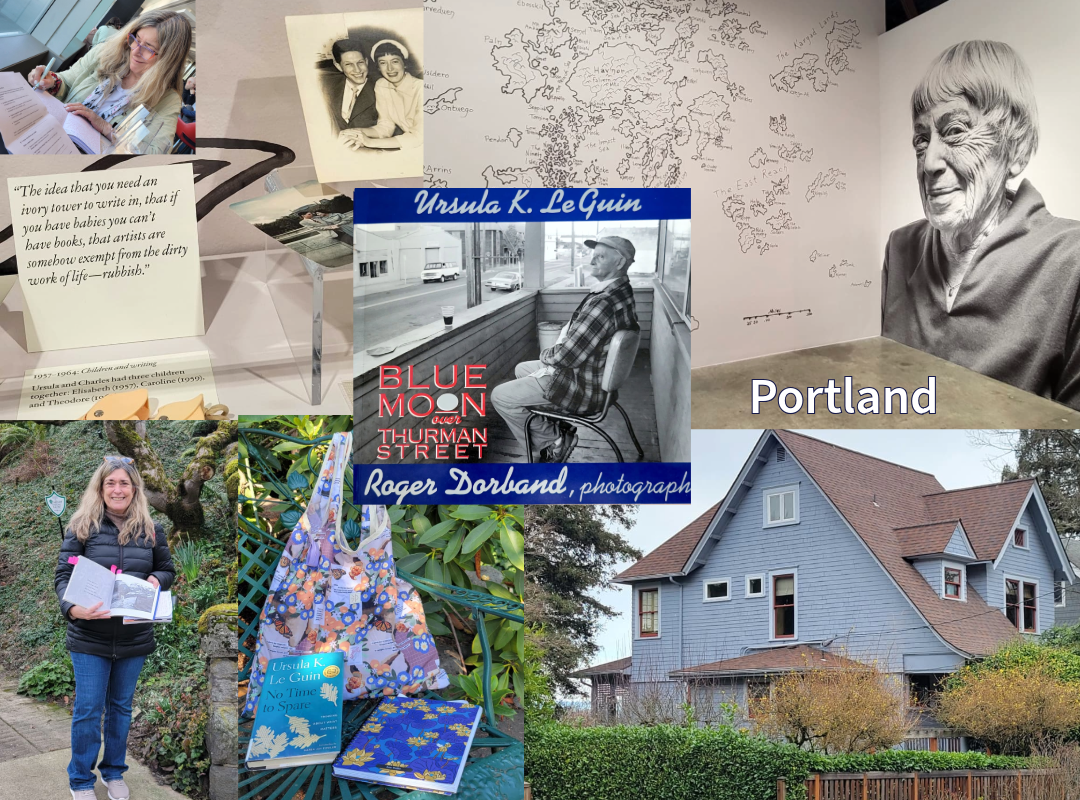
In August 2025, I discovered, almost by chance, that Ursula K. Le Guin had lived much of her life in Portland, Oregon. At the time, I knew relatively little of her work. I had only read The Carrier Bag Theory of Fiction and No Time to Spare, and had been drawn to her clear-eyed perspective and good sense of humor. Learning that her house was only half an hour from mine immediately sparked my curiosity.
While searching for information about the author, I discovered that, in addition to her books of essays, science fiction, and fantasy, as well as her translations and children’s literature, Le Guin had written a book in the late 1980s called Blue Moon over Thurman St dedicated to Thurman Street—the street where she lived—accompanied by photographs taken by Roger Dorband.
That got me excited. I had moved from Buenos Aires to the Pacific Northwest almost ten years earlier, and I was curious to know what Portland had been like long before I ever imagined I would one day live in this part of the world. I thought Blue Moon might give me some clues about that past and, at the same time, allow me to get to know the place where Ursula Le Guin had lived with her family and written for so many years.
I went out looking for Blue Moon at used bookstores, but I had no luck: the book was out of print. I only knew one line from it: “To walk a street is to be told a story.” With that sentence as my guide, I decided to go to Thurman St. and see what stories might unfold as I walked down that street. And so, on a sunny Saturday in September 2025, I grabbed my camera and a notebook and set out on an adventure.


I started walking along Thurman Street from 27th Avenue, heading toward Forest Park. As I walked, the scenery changed. After crossing the bridge over Lower Macleay Park, the street began to climb, and houses appeared at different levels on either side of the sidewalk. Below lay the park and Balch Creek; further ahead, the asphalt gave way to the entrance of Forest Park, an urban forest of about two thousand hectares that stretches across the hills of northwest Portland.
I focused on the sounds: birds, voices and laughter, conversations among neighbors, the occasional bark. Dogs are a fundamental part of the Portland landscape. I saw families with children in strollers, lots of bicycles, and people jogging with their dogs toward the woods.


I found Le Guin’s house, painted sky blue, surrounded by immense trees, with rosebushes along the sidewalk that were beginning to wilt with the arrival of fall. Had she planted them herself? Was the window overlooking Mount St. Helens the one in her study? I imagined her writing and watching the steady rain during the long winters. I wondered if she had ever walked through Forest Park and if any of her fictional characters or poems had emerged from those walks through the woods.


I also imagined Ursula and Roger making decisions about what to photograph and what to leave out, sharing what caught their eyes. One thought stayed with me throughout the tour: What could have led them to dedicate a book to Thurman Street?
In February 2026, I found out that it was the last weekend to visit A Larger Reality, an exhibition dedicated to the work of Ursula K. Le Guin and curated by her son, Theo Downes-Le Guin. Despite the bad weather—I still haven’t quite got used to the winter rain—I headed out to the Oregon Contemporary. I didn’t want to miss it.

Several things caught my attention: a giant poster featuring Le Guin’s face alongside maps of the worlds she imagined for her science fiction books, a folder containing rejection letters for some of her works, family photos, handwritten notes, her typewriters, sketchbooks, and some very worn-out colored pencils that I found endearing.
There was also a mural titled Influences and Gravitations, dedicated to people Le Guin admired, and among the many faces I recognized Jorge Luis Borges, another small, unexpected connection to Argentina.

In one of the rooms, underneath what looked like a tree, were all her books. And there, finally, I found Blue Moon over Thurman St. I opened it and felt my hands trembling with excitement. I wanted to tell everyone around me about my walk down Thurman Street and how long I’d been looking for that book.

The landscape-format book features black-and-white photos accompanied by notes and poems—several of them handwritten—with a special section containing references to the places that were photographed. A historical gem.
I went back home and this time searched for Blue Moon until I found a copy. When I received it a few days later, I pored over it as if it were a treasure: I filled it with Post-it notes, took notes, and one Saturday in February 2026, I returned to Thurman Street—but this time with the book.
With the book in my hand, I tried to recognize where those photos were taken nearly four decades ago. Some of the places seemed unchanged despite the passage of time; others were gone. I asked a woman to take a photo of me recreating one of the scenes from the book, which featured a boy. Would the people who lived there know that their homes had been featured in a book published years ago by one of their neighbors?


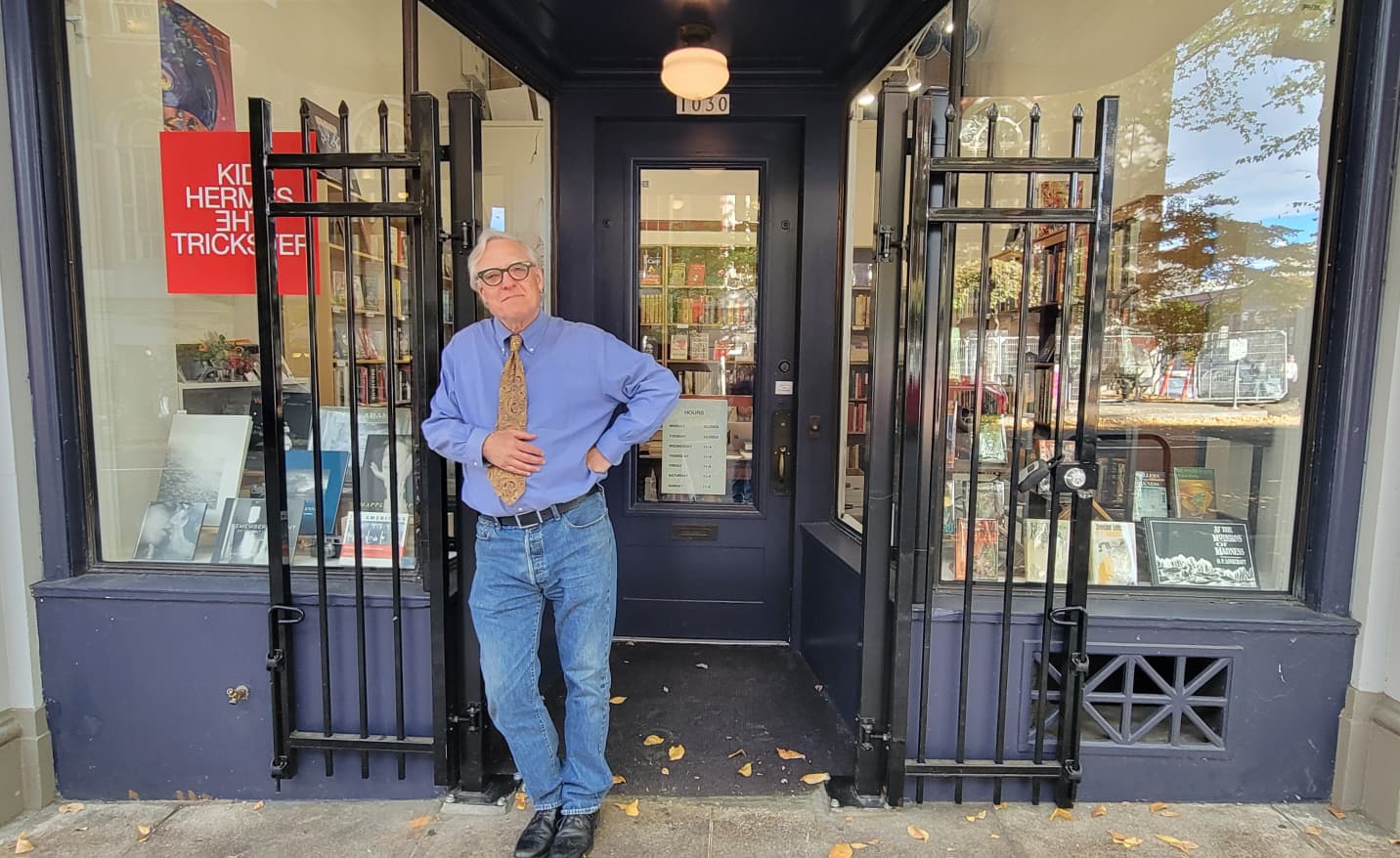
During my walk, I came across another surprise: the so-called “tin house,” a building that was under construction when the photographs for the book were taken and which now houses the independent bookstore Bishop & Wilde.

August 1986

January 1987

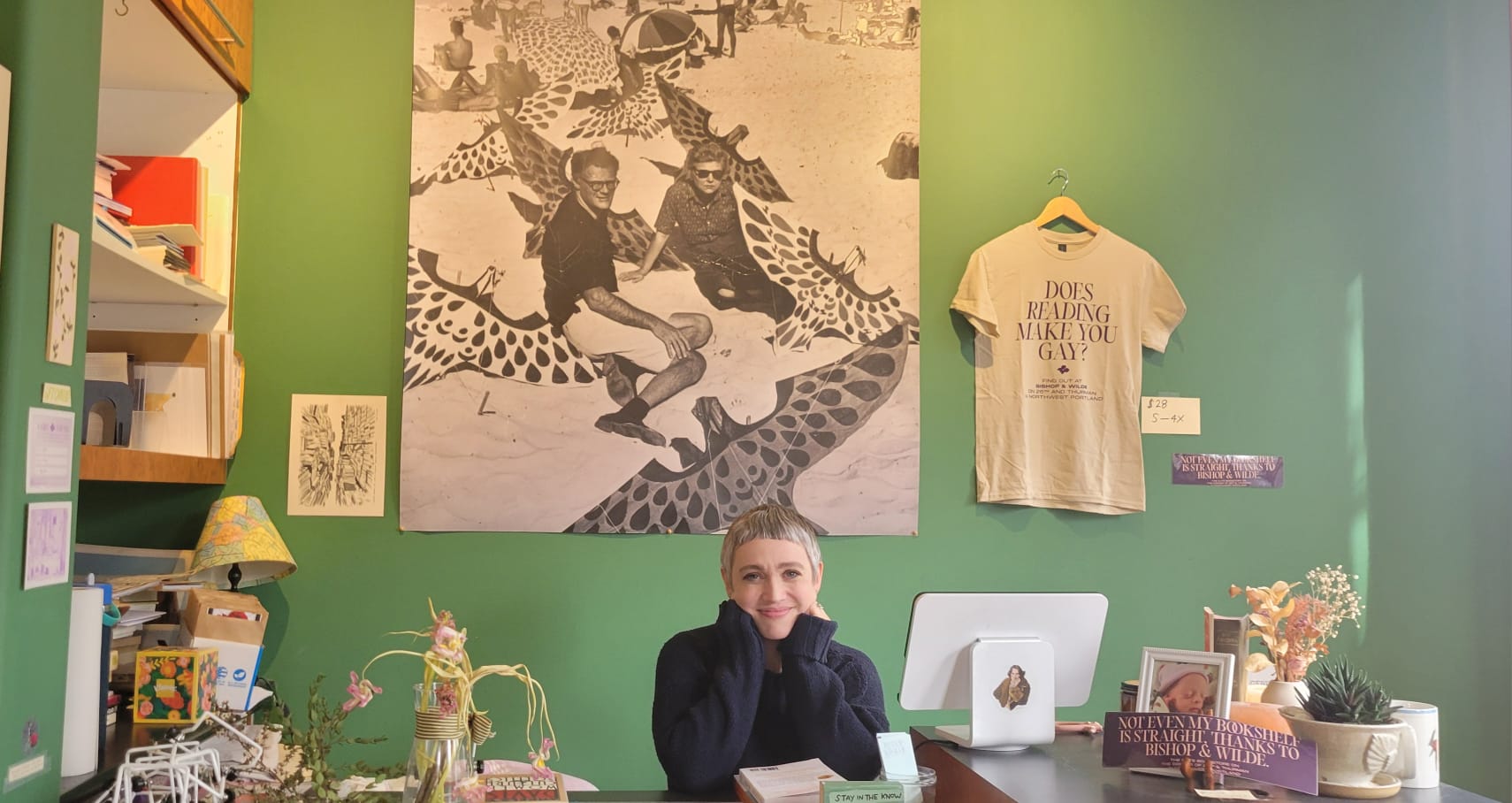
I went inside and talked with Melissa, a poet and the owner of the bookstore. She knew about Blue Moon, but she didn’t know that the building where her business is located today was featured in its pages. It still makes me smile to remember her enthusiasm as she flipped through the pages over and over again and took photos of the book, surprised to discover a piece of the history of the place where her bookstore now stands.

When I read Blue Moon over Thurman St., I understood why Ursula Le Guin had wanted to write it. In the late 1980s, after living on that street for twenty-five years, she saw that the neighborhood was changing—and not necessarily for the better. Houses that were still in good condition were being demolished to make way for new developments aimed at people with greater purchasing power. In the early ’90s, when the book was published, Le Guin was already writing about gentrification and about the residents who were being forced out of the neighborhood. She and Dorband, who also lived in the area, found in words and images a way to document what was happening.

The community gardens


Before reading the book, I had imagined I would find a sort of nostalgic stroll down a beloved street. But Blue Moon showed me something I hadn’t expected: a street marked by the changes that Le Guin and Dorband saw all around them, which they decided to document before those traces disappeared.
I had known Portland for barely ten years; they were showing me part of a neighborhood that existed before I arrived—one that, in many ways, had ceased to exist. Walking down Thurman Street again after reading the book was, in a way, like walking down a different street. The places were the same, but now I could see something that had remained invisible during my first visit: the stories of those who had been there before, what had changed, and also what had been lost.


That day I found myself standing in front of Le Guin’s house once again. Her family had donated it to Literary Arts, and the organization is working to turn it into a writers’ residency. I thought about how much Thurman Street had changed since Le Guin and Dorband portrayed it in Blue Moon.
In June 2026, I learned that the house had been listed on the National Register of Historic Places—great news.
Perhaps, someday, a writer passing through the future writers’ residence will follow the path that Ursula and Roger blazed forty years ago.
Notes and references
The Ursula K Le Guin Foundation https://www.ursulakleguin.com/foundation
Ursula K Le Guin https://www.instagram.com/ursulakleguin/
Literary Arts https://www.instagram.com/literaryarts/
Bishop and Wilde Books https://www.instagram.com/bishopandwilde/
An article about A larger reality written by Theo Downes-Le Guin https://hyperallergic.com/curating-a-show-on-my-ineffable-mother-ursula-k-le-guin/
Worlds of Ursula K Le Guin https://www.ursulakleguin.com/documentaries
* While searching for information about Blue Moon over Thurman St. in February 2026, I came across the news that Roger Dorband had passed away in October 2025 in Astoria, Oregon, where he lived.
Español
En agosto de 2025 descubrí, casi por casualidad, que Ursula K. Le Guin había vivido gran parte de su vida en Portland, Oregon. En ese momento conocía poco de su obra: solo había leído La teoría de la bolsa de la ficción y Sin tiempo que perder y me había atraído su mirada lúcida y el humor que aparecía con frecuencia en sus textos. Enterarme de que su casa estaba a media hora de la mía despertó de inmediato mi curiosidad.
Buscando datos sobre la autora encontré que, además de sus libros de ensayos, ciencia ficción, traducciones y literatura infantil, Le Guin había escrito, a fines de los ochenta, Blue Moon over Thurman Street dedicado a Thurman Street, la calle donde vivía acompañado por fotografías tomadas por Roger Dorband.
Eso me entusiasmó. Yo había llegado desde Buenos Aires a la zona del oeste del Pacífico (PNW) hacía casi diez años y sentía curiosidad por saber cómo había sido Portland mucho antes de que imaginara que algún día viviría en esta parte del mundo. Pensé que Blue Moon podía darme algunas pistas sobre ese pasado y, al mismo tiempo, permitirme conocer el lugar donde Ursula Le Guin había vivido con su familia y escrito durante tantos años.
Salí a buscar Blue Moon over Thurman St. en librerías de usados, pero no tuve suerte: el libro estaba agotado. Solo conocía una frase: “To walk a street is to be told a story”, que me permito traducir como: Caminar una calle es dejar que te cuente una historia. Con esa frase como guía decidí ir a Thurman St. y descubrir qué historias podían surgir caminando por ella. Fue así que un sábado soleado de septiembre de 2025 busqué mi cámara, un cuaderno y salí hacia la aventura.
Empecé a caminar por Thurman Street desde la 27th Avenue, en dirección a Forest Park. A medida que avanzaba, el paisaje iba cambiando. Después de cruzar el puente sobre Lower Macleay Park, la calle comenzaba a subir y las casas aparecían a diferentes niveles a cada lado de la acera. Debajo quedaban el parque y Balch Creek; más adelante, el asfalto terminaba hasta convertirse en la entrada de Forest Park, un bosque urbano de alrededor de dos mil hectáreas que se extiende por las colinas del noroeste de Portland.
Me concentré en los sonidos: pájaros, voces y risas, conversaciones entre vecinos, algún que otro ladrido. Los perros son parte fundamental del paisaje de Portland. Vi familias con niños en carritos, muchas bicicletas y gente trotando con sus perros en dirección al bosque.
Encontré la casa de Le Guin rodeada de árboles inmensos, pintada de color celeste y con rosales en la vereda que comenzaban a marchitarse con la llegada del otoño. ¿Los habría plantado ella? ¿La ventana con vista al volcán St. Helens habría sido la de su estudio? La imaginé escribiendo y mirando la lluvia constante durante los largos inviernos. Pensé si habría caminado por Forest Park y si alguno de sus personajes de ficción o poemas habría surgido de esos paseos por el bosque.
También imaginé a Ursula y Roger tomando decisiones sobre qué fotografiar y qué dejar afuera, compartiendo aquello que le llamaba la atención a cada uno. Un pensamiento me acompañó durante el recorrido: ¿qué los habría llevado a dedicarle un libro a Thurman Street?
En febrero de 2026 me enteré de que era el último fin de semana para visitar A Larger Reality, una muestra dedicada a la obra de Ursula K. Le Guin y curada por su hijo, Theo Downes-Le Guin. A pesar del mal tiempo, todavía no termino de acostumbrarme a la lluvia del invierno, salí rumbo al Oregon Contemporary. No quería perdérmela.
Varias cosas me llamaron la atención: una gigantografía con la cara de Le Guin junto con los mapas de los mundos imaginados para sus libros de ciencia ficción, una carpeta donde se guardaban cartas de rechazo de algunas de sus obras, fotos familiares, notas manuscritas, sus máquinas de escribir, libretas de dibujos y unos lápices de colores muy gastados que me dieron ternura.
También había un mural titulado Influences and Gravitations, dedicado a personas que Le Guin admiraba donde reconocí a Jorge Luis Borges, otra pequeña e inesperada conexión con Argentina.
En una de una de las salas, debajo de lo que simulaba ser un árbol, estaban todos sus libros. Y allí, finalmente, me encontré con Blue Moon over Thurman St. Lo abrí y sentí que me temblaban las manos de la emoción. Me dieron ganas de contarles a todos los que estaban alrededor sobre mi caminata por Thurman Street y cuánto había buscado ese libro.
El libro de formato apaisado, tiene fotos en blanco y negro acompañadas por notas y poemas, varios de ellos manuscritos, con un apartado especial con referencias a los lugares que fueron fotografiados. Una joya histórica.
Volví a mi casa y esta vez busqué Blue Moon hasta encontrar un ejemplar. Cuando lo recibí unos días más tarde, lo revisé como si se tratara de un tesoro: lo llené de post-its, tomé notas y un sábado de febrero del 2026 volví a Thurman Street pero esta vez acompañada por el libro.
Fui tratando de reconocer los lugares que aparecían en aquellas fotos tomadas casi cuatro décadas atrás. Algunos parecían intactos a pesar del paso del tiempo; otros ya no estaban. Le pedí a una mujer que me sacara una foto recreando una de las escenas del libro, en la que aparecía un niño. ¿Sabrían quienes vivían allí que sus casas habían formado parte de un libro publicado años atrás por una de sus vecinas?
Durante la caminata encontré otra sorpresa: la llamada “casa de latón”, un edificio que estaba en construcción cuando se hicieron las fotografías del libro y donde en la actualidad funciona la librería independiente Bishop & Wilde.
Agosto 1986
Enero 1987
Entré y conversé con Melissa, poeta y dueña de la librería. Ella conocía la existencia de Blue Moon, pero no sabía que el edificio donde hoy funciona su negocio aparecía retratado en sus páginas. Todavía me hace sonreír recordar su entusiasmo mientras pasaba las páginas una y otra vez y sacaba fotos del libro, sorprendida de descubrir allí una parte de la historia del lugar que ahora ocupaba su librería.
Cuando finalmente leí Blue Moon over Thurman St., entendí por qué Ursula Le Guin había querido escribirlo. A fines de los ochenta, después de vivir veinticinco años en esa calle, veía que el barrio estaba cambiando y no necesariamente para bien. Casas que todavía estaban en buenas condiciones eran demolidas para dar lugar a nuevas construcciones destinadas a personas con mayor poder adquisitivo. A comienzos de los noventa, cuando se publicó el libro, Le Guin ya escribía sobre la gentrificación y sobre los vecinos que estaban siendo empujados a dejar el barrio. Ella y Dorband, que también vivía en la zona, encontraron en las palabras y las imágenes una manera de dejar registro de lo que estaba sucediendo.
Jardines comunales
Nuevas construcciones
Antes de leer el libro, me había imaginado que encontraría una especie de recorrido nostálgico por una calle querida. Pero Blue Moon me mostró algo que no esperaba: una calle atravesada por los cambios que Le Guin y Dorband veían a su alrededor, y que decidieron registrar antes de que esas huellas desaparecieran.
Conocía Portland desde hacía apenas diez años; ellos me estaban mostrando parte de un barrio anterior a mi llegada, uno que en muchos aspectos había dejado de existir. Volver a caminar por Thurman Street después de leer el libro fue, de alguna manera, caminar por otra calle. Los lugares eran los mismos, pero ahora podía ver algo que durante mi primera visita había permanecido invisible: las historias de quienes habían estado allí antes, lo que había cambiado y también lo que se había perdido.
Ese día volví a pararme frente a la casa de Le Guin. Su familia la donó a Literary Arts y esta institución está trabajando para convertirla en una residencia para escritores. Pensé en todo lo que había cambiado Thurman Street desde que Le Guin y Dorband la retrataron en Blue Moon.
En junio de 2026 me enteré que la casa fue incorporada al National Register of Historic Places, una gran noticia.
Quizás, algún día, una escritora o un escritor que pase por la futura residencia retome el camino que Ursula y Roger trazaron hace cuarenta años atrás.

Notas y referencias
The Ursula K Le Guin Foundation https://www.ursulakleguin.com/foundation
Ursula K Le Guin https://www.instagram.com/ursulakleguin/
Literary Arts https://www.instagram.com/literaryarts/
Bishop and Wilde Books https://www.instagram.com/bishopandwilde/
Una nota sobre A larger reality escrita por Theo Downes-Le Guin https://hyperallergic.com/curating-a-show-on-my-ineffable-mother-ursula-k-le-guin/
Worlds of Ursula K Le Guin https://www.ursulakleguin.com/documentaries
* Mientras buscaba información sobre Blue Moon over Thurman St. en febrero de 2026, me encontré con la noticia de que Roger Dorband había fallecido en octubre de 2025 en Astoria, Oregon, donde vivía.


Deja una respuesta